Category: Accounting Resources

  • Why You’re Not Seeing the Best Talent in Central California

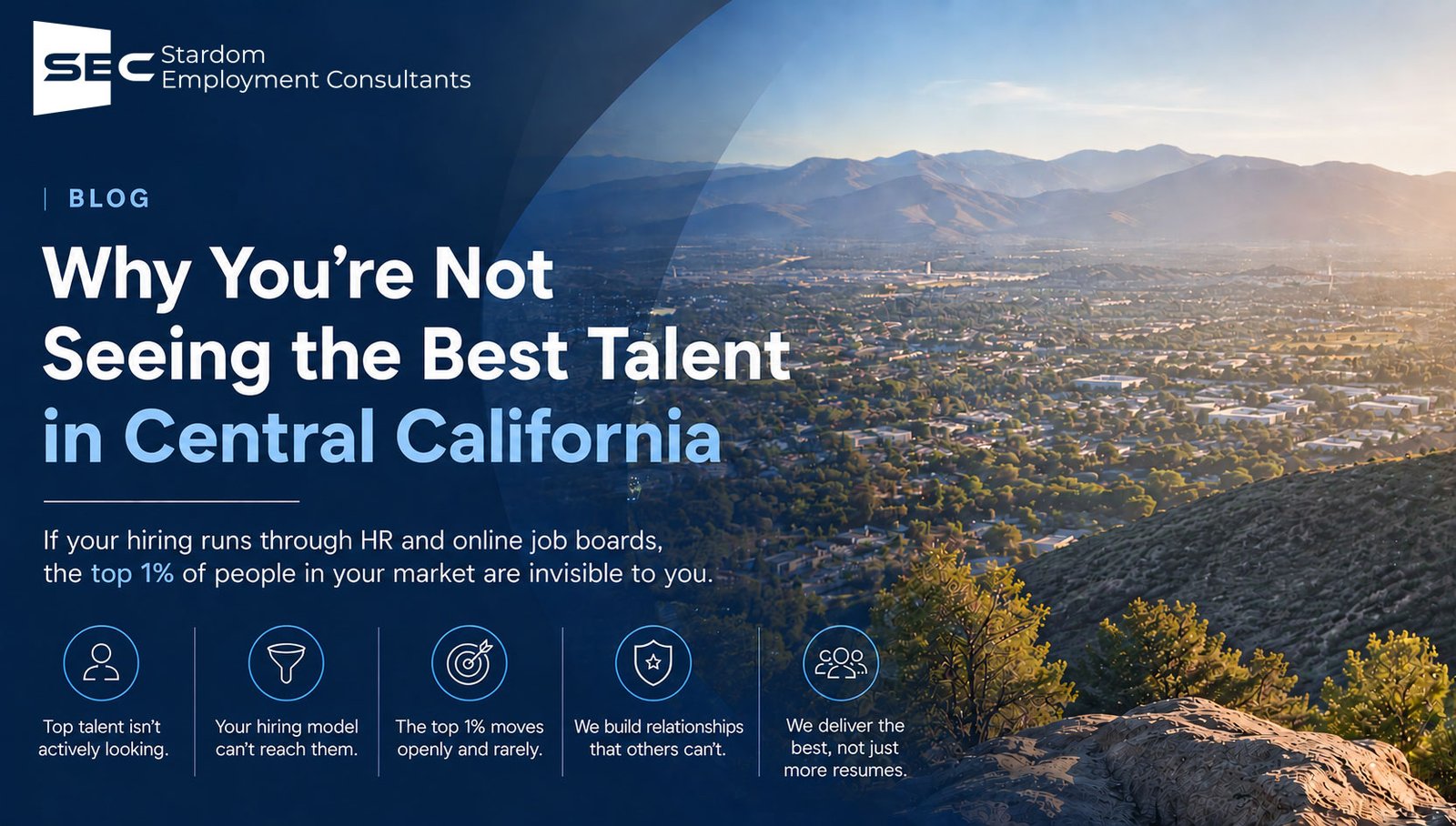
    Why You’re Not Seeing the Best Talent in Central California

    If your hiring runs through HR and online job boards, the top 1% of people in your market are invisible to you.

    I’m not talking about candidates who look polished on paper. I mean the people who actually drive revenue, keep operations from sliding sideways, and make the rest of the team better just by being in the room. Those people aren’t applying to your req. They’re not posting “open to work.” A lot of them barely log into LinkedIn. They’re heads-down at the company they’re already at.

    And missing them costs more than owners think.

    What a “decent” hire really runs you

    You hire a finance manager at $120K. Resume’s strong, interview goes well, culture fit. Six months in you can tell — they’re fine. Not fireable. Not someone who’s going to push the business anywhere either.

    Add it up:

    • Six months of salary and benefits: about $75,000
    • Lost productivity and the deals or decisions they didn’t move on: $50K to $150K
    • Drag on the team (rework, leadership time spent managing them, morale): $25K and up
    • Replacing them once you finally pull the trigger: another $30K to $60K

    You’re $180K to $310K in on one mediocre hire.

    A top 1% person in that same seat is a different story. They spot $200K of waste a year. Their reports are clean enough that you actually trust them to make decisions on. The other strong people on your team stop polishing their resumes because they finally have a peer. You get your evenings back.

    It’s not a hire. It’s a multiplier.

    Why your current model can’t reach them

    HR isn’t the problem here. The system they’re handed is.

    Internal recruiting is built for volume, speed, and compliance. It isn’t built to find someone who’s already great at their job and has zero reason to leave. So you end up pulling from the same pool every other company in Fresno is pulling from, rewarding people who are actively looking instead of people who are actively winning, and judging by resume bullets instead of reputation.

    It’s an efficient process. It just isn’t the one that gets you the best person.

    How the top 1% actually move

    They don’t behave like job seekers. They’re loyal to where they are. They ignore generic recruiter pings (rightly). They take a call when somebody they already trust is on the other end, and basically never before that. They’re open to the right opportunity, but that opportunity almost never arrives in their inbox.

    If you’re not reaching them on purpose, somebody else is.

    Getting in front of them takes credibility in the market, relationships you’ve built over years, and the ability to frame an opportunity in a way that makes sense to somebody who wasn’t even looking that morning. That’s not a job board doing the work. That’s a relationship doing the work.

    Where Stardom comes in

    We don’t sit in the same lane as your HR team. We’ve spent years building off-market relationships with the people we know are quietly worth talking to. We know which of them are locked in and which would actually pick up the phone for the right call. And when the conversation happens, we know how to position what you’re offering so it actually lands.

    We get you in front of people your internal pipeline will never see.

    The honest question

    Is your hiring built around who’s visible, or around who would actually change the trajectory of your business?

    Because if it depends on who applies online, you’re not competing for the best people in Central California. You’re competing for the most available ones, and those are very different groups.

    A bad hire costs you money, momentum, and basically a year of your team’s progress. A great one buys all of that back. The top 1% aren’t ignoring you. They’re just not where you’re looking for them.

    If you’re serious about the next chapter of your company, it’s worth being honest with yourself about whether your current way of hiring is actually built for it.

    #ThrivingCentralCaliforniaCompanies

    Want to talk through it? Call me.

    — Lorenzo Ramirez

  • Accounting Software Series: QuickBooks vs Sage vs Xero

    Choosing the right accounting software is one of the most consequential decisions a Fresno business can make. The wrong choice means hours of manual workarounds; the right one means your accountants spend time on analysis instead of data entry. Here’s how QuickBooks, Xero, and Sage stack up in 2026.

    QuickBooks Online

    QuickBooks Online is the dominant accounting platform in the United States — over 7 million businesses rely on it. For Fresno-area companies, this matters: most local accountants, bookkeepers, and CPAs already know QuickBooks, which cuts onboarding time for new hires.

    Pricing (2026):

    • Solopreneur: $20/month
    • Simple Start: $38/month
    • Essentials: $75/month (3 users)
    • Plus: $115/month (5 users)
    • Advanced: $275/month (25 users)

    Strengths:

    • US payroll built in (add-on from $50/month + $6.50/employee)
    • 750+ integrations including major ATS and HR platforms
    • Best-in-class US tax reporting and 1099/W-2 generation
    • QuickBooks Online Advanced is the standard for mid-market staffing agencies

    Best for: US-based businesses, accounting firms, staffing agencies, companies with complex payroll needs.

    Xero

    Xero launched in New Zealand in 2006 and now serves 3.9 million subscribers globally. Its standout feature is unlimited users on every plan — rare in accounting software.

    Pricing (2026): Starter, Standard, and Premium tiers (USD pricing varies; UK entry starts at ~£15/month equivalent).

    Strengths:

    • Unlimited users on every plan (ideal for growing teams)
    • 800+ app marketplace — the widest integration ecosystem
    • AI assistant grew 61% in 2026; strong automation for bank reconciliation
    • Best for international operations and multi-currency businesses

    Best for: International businesses, ecommerce companies, teams needing unlimited users, businesses running on a stack of SaaS tools.

    Sage

    Sage is the most affordable entry point of the three and bundles payroll at no extra per-module cost — a significant saving for businesses with 10+ employees.

    Pricing (2026): Sage Accounting Start from ~$14/month equivalent; Sage Accounting for full features.

    Strengths:

    • Payroll bundled (no add-on fee — advantage over QB for 10+ employees)
    • Best inventory, job costing, and manufacturing features
    • Strong compliance tools for mid-market businesses
    • Well-suited for distribution, construction, and product-based companies

    Best for: Manufacturing, construction, distribution companies; businesses where bundled payroll saves money.

    Side-by-Side Comparison

    FeatureQuickBooksXeroSage
    US starting price$20/monthVaries~$14/month
    US payrollBuilt-in add-onThird-partyBundled
    User limit (base plan)1Unlimited1
    Integrations750+800+200+
    Best forUS/staffingInternationalManufacturing
    AI featuresStrongGrowing (61% YoY)Moderate

    Which Is Best for a Staffing Agency?

    For accounting and finance staffing agencies operating in the US — particularly in California’s Central Valley — QuickBooks Online Advanced wins. Here’s why:

    1. Candidate familiarity: The accountants and finance professionals you hire almost universally know QuickBooks. Placing candidates in QB environments is frictionless.
    2. Payroll for temps: QuickBooks Payroll handles contractor and temporary worker payroll natively.
    3. Reporting: QB Online Advanced has the reporting depth needed for multi-client billing, placement tracking, and AR management.
    4. Local accountant ecosystem: Fresno CPAs and bookkeepers default to QuickBooks. Your outsourced accounting team will already know it.

    Stardom Employment Consultants uses QuickBooks Online Advanced for its own operations — so we’re not guessing.

    The Bottom Line

    Choose QuickBooks if you’re a US-based business, staffing agency, or accounting firm that needs strong payroll integration and local accountant compatibility.

    Choose Xero if you operate internationally, need unlimited users, or run a tech-forward business with many SaaS integrations.

    Choose Sage if you’re in manufacturing, distribution, or construction — or if you want payroll bundled without a separate monthly add-on.


    Looking for accounting and finance professionals who know these tools? Stardom Employment Consultants places QuickBooks, Xero, and Sage-certified talent across Fresno and Central California.

    Browse Open Accounting Roles | Request Talent